Printer
Friendly Version
Testing New Designs In the Loop, Not On the OvalThe Virtual Vehicle Transmission Test Cell can save valuable time for auto designers. By Gary Stecklein
For a major automotive manufacturer, producing an all-new vehicle is an exercise not just in design and engineering, but also in logistics and timing. Major components such as the engine, transmission and body must be designed and developed, then integrated at the earliest possible time so that the finished product can be thoroughly proven and still brought to market on time.
Each component of the new vehicle is designed from the start with this integration in mind. However, the final development and validation of each powertrain component — engine, transmission and body — traditionally has had to wait until all three could be integrated into a completed prototype vehicle and driven on a test track. This whole-vehicle method of validation testing, while necessarily expensive and time-consuming, has been the rule. But a delay in developing any of the major components can jeopardize the whole vehicle's production schedule. Transmission validation, for example, can't begin until the engine is ready. If the engine prototype encounters teething problems, the whole vehicle program schedule can be held up for months. Even assuming timely delivery of components, testing a prototype on a test track with a human driver has its shortcomings. Such testing is often subjectively controlled and exact conditions often are unable to be repeated. Vehicle tests also are subject to weather changes and other environmental factors that can change from test to test and even while a test is in progress. On the other hand, engine-driven (test cell) testing requires special facilities with exhaust removal systems and fuel storage capabilities. Engines also require maintenance during lengthy durability tests. The solution is to develop a transmission test system that can simulate all characteristics of an engine and vehicle through the use of properly controlled electric motors. The reasoning behind this solution is that even if the new engine or vehicle does not yet exist, there are computer-based models that can predict the performance of a concept engine or the loads of a vehicle.
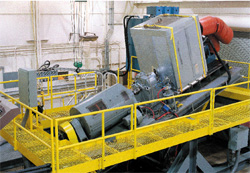
Virtual Vehicle Transmission Test CellEngineers at Southwest Research Institute (SwRI) have built a hardware-in-the-loop test cell for powertrains that allows manufacturers to reduce the time and cost associated with developing and validating transmissions. The test stand eliminates the need for on-track vehicle testing and allows transmission engineers to work in parallel, not in tandem, with their engine and body counterparts. Developed under sponsorship from General Motors and in cooperation with Anderson Electric Controls Inc., the Virtual Vehicle Transmission Test Cell uses a specially built, low-inertia AC electric motor, coupled with SwRI's sophisticated engine and vehicle performance simulation software, to simulate both the engine and the vehicle while testing a prototype transmission. It also includes an environmental conditioning system and a road-grade tilt feature. The test cell's electric drive motor replicates gasoline-engine speed and torque during normal operation, simulates engine inertia during shifting and reproduces first-order engine torsionals, which are the twisting forces imparted to the crankshaft as each cylinder fires. These capabilities are provided by a specially constructed, high-power AC motor rated at 330 kilowatts (kW) continuous, with an overpower capability for short periods such as during inertia simulation. A second electric motor absorbs the power from the transmission and replicates vehicle loads typically placed on the transmission, such as vehicle inertia during acceleration, road grade, aerodynamic drag and rolling resistance. The test cell's input dynamometer can simulate engines of four, six and eight cylinders, with displacements ranging from 1.5 liters to 5 liters, in terms of engine speed, torque, inertia and torsionals. The output dynamometer can simulate vehicle weights from 2,500 pounds to 14,000 pounds. Finally, the environmental chamber can simulate temperatures from –40 to 240 degrees Fahrenheit, and the test cell's tilt feature can simulate slopes as great as 45 degrees above and below the horizon. The test cell's modeling and simulation system consists of commercial off-the-shelf hardware and software and other SwRI-developed Rapid Prototyping Electronic Control System (RPECS) software to simulate entire powertrains, vehicles, operators and terrain. This software, called RAPTOR® VSM (Rapid Automotive Performance SimulaTOR for Vehicle System Modeling) was developed for automotive designers to assess vehicle economy and performance. It allows engines, transmissions and other drivetrain components to be simulated in modeled vehicles, in virtual environments, with modeled operators. In the hardware-in-the-loop test cell application, RAPTOR® VSM allows engineers to replace the virtual or modeled transmission with a prototype transmission to test its operating characteristics within the simulated world around it. The test cell's realistic simulation allows development engineers to evaluate the transmission's performance and efficiency, as well as assess its control features and its durability under simulated driving cycles much more quickly and at less expense than with traditional development and validation methods. Data gathered during the simulation tests can be compared against the predicted transmission and transmission control system performance developed during the design phase. The differences can be quantified to improve future design efforts. Product validation is enhanced because the test system allows transmission performance to be evaluated in a range of vehicles with different engines by changing software rather than by changing hardware. This capability greatly reduces the time required to perform tests. The range of simulation is remarkable: The test cell already has been used to test a prototype transmission before the vehicle for which it was designed was actually available. It also has been used to create "virtual test tracks" with a wide range of conditions that may not exist in any single test track. It can be programmed to simulate any number of terrains and environmental conditions. Other Powertrain ApplicationsIn addition to transmissions, the Virtual Vehicle Transmission Test Cell can be used to test other powertrain components such as transaxles, engines, transfer cases, differentials and four-wheel drive systems. For transaxles, two testing configurations can be provided, with one or two absorption dynamometers. When one dynamometer is used, the output half-shafts from the transaxle must be coupled to gearboxes that, in turn, are coupled to a single dynamometer to absorb power. With two dynamometers, the half-shafts are coupled directly to two dynamometers for power absorption. The testing performed is otherwise similar to transmission testing. Four-wheel drive test configurations also can be provided. When applied to engines, the test cell's high-power AC motor is used to replicate the loads imposed by the transmission and all downstream drivetrain hardware, as well as the vehicle loads that are developed during operation. In this case, transmission-shift shock loads and drivetrain inertial loads must be imposed on the engine exactly as they would be in a vehicle. Again, modeling and simulation are the backdrop for the entire testing and validation process. Engine calibration can be undertaken with simulated transmission characteristics including the clutching and changing reflected in the inertial characteristics imposed on the engine. Similarly, the test system can be used to evaluate performance of other drivetrain components such as transfer cases and differentials, or smaller components such as starters and alternators. For these components, torsional simulation can be important for product verification. The system also allows testing of four-wheel drive systems. In this instance, it is especially important to simulate the interactions that occur between the tire and the road during operation on surfaces with both good and poor traction. In this test mode, often referred to as stick-slip or variable coefficient of traction testing, the system consists of five dynamometers: one to provide power and the other four to absorb the power at the location of the four wheels. Similar test systems could be developed to test electric motors, hybrid-vehicle battery packs and other equipment under a variety of road and environmental conditions. Detailed simulation and dynamometer testing traditionally have been performed as two separate steps in the vehicle development process. While some transient behaviors could be implemented in the modeling phase, the limitations of dynamometers to provide realistic transient conditions has meant that transient assessment and calibration could only be performed during actual vehicle testing. This problem is exacerbated by the introduction of hybrid electric vehicle systems, which have a much greater number of components to be tested than do conventional vehicles.
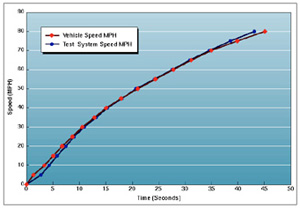
ConclusionThe ability of a single, low inertia output motor to simulate a range of combustion engines was verified for gasoline engines from 2.2 to 6 liters during testing. A single output dynamometer was used to simulate a variety of vehicles under different vehicle weight and road load conditions. The performance of the test system was quantified by comparing measured parameters on the test system to values measured during actual vehicle tests. With the Virtual Vehicle Transmission Test Cell, SwRI engineers have developed a system that combines simulation, testing and calibration in a single test environment. New control simulation algorithms can be developed and dynamometer testing can be made more realistic than ever before. Consequently, less actual vehicle testing is required, resulting in a reduction in time and cost for developing new vehicle designs. Comments about this article? Contact Stecklein at (210) 522-2973, or mailto:gstecklein@swri.org;com67@swri.org;jfohn@swri.org?subject=Summer 2003 Technology Today--Testing New Designs in the Loop Published in the Summer 2003 issue of Technology Today®, published by Southwest Research Institute. For more information, contact Joe Fohn. Technics
|
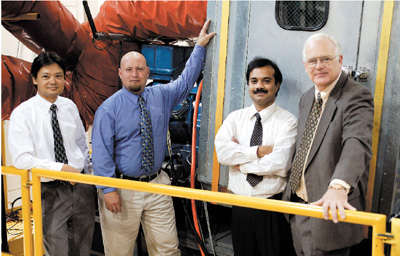 Design team members for the virtual vehicle
transmission test stand include (from left) SwRI engineers Joe
Steiber, Matthew Castiglione, Bapiraju Surampudi and Gary
Stecklein, all of the Vehicle Systems Research Department.
Stecklein is director of the Vehicle Systems Research
Department of the Engine and Vehicle Research Division. As
director, he is responsible for development of automotive
transmission, hydraulic system, and electric and
hybrid-electric vehicle technologies, as well as contamination
research. A mechanical engineer, he holds nine U.S. patents.
Steiber is a senior research engineer in the Advanced Vehicle
Technology section, Castiglione is a research engineer in the
Drivetrain Engineering section, and Surampudi is a senior
research engineer in the Hydraulic and Fuel Systems
Development section.
Design team members for the virtual vehicle
transmission test stand include (from left) SwRI engineers Joe
Steiber, Matthew Castiglione, Bapiraju Surampudi and Gary
Stecklein, all of the Vehicle Systems Research Department.
Stecklein is director of the Vehicle Systems Research
Department of the Engine and Vehicle Research Division. As
director, he is responsible for development of automotive
transmission, hydraulic system, and electric and
hybrid-electric vehicle technologies, as well as contamination
research. A mechanical engineer, he holds nine U.S. patents.
Steiber is a senior research engineer in the Advanced Vehicle
Technology section, Castiglione is a research engineer in the
Drivetrain Engineering section, and Surampudi is a senior
research engineer in the Hydraulic and Fuel Systems
Development section.