Active Lab Courses
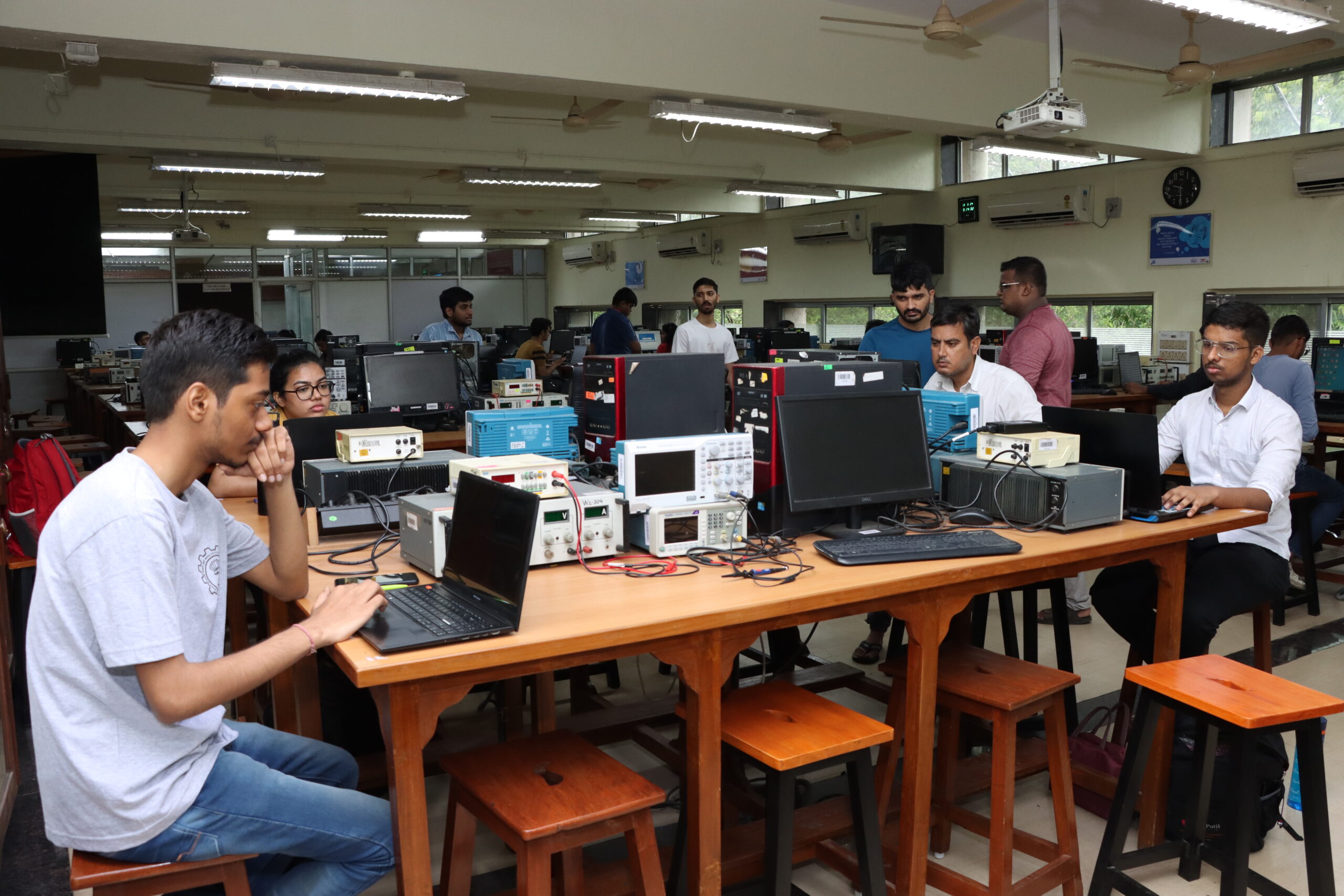
The Electronics Design Lab (EE 344) course, a capstone design course at the Department of Electrical Engineering, IIT Bombay, empowers students to develop electronic products from concept to prototype. It covers key aspects such as analog and digital circuit design, embedded systems, PCB layout, and signal conditioning. Students work on group projects involving microcontrollers, CPLDs, and FPGAs, leading to the implementation of real-world applications
READ MOREThe Analog Circuits Laboratory (EE 230) is a core lab course designed for undergraduate students in Electrical Engineering. It focuses on hands-on experiments with analog circuit components, including operational amplifiers (Op-Amps), transistors (BJTs and FETs), and feedback systems.
The Digital Circuits Laboratory (EE 214) is a hands-on lab course designed for undergraduate students in Electrical Engineering. It focuses on practical applications of digital logic design, covering topics such as combinational and sequential circuits, flip-flops, counters, multiplexers, and microcontroller-based systems.
The Microprocessor Laboratory (EE 337) at IIT Bombay is a hands-on course designed to teach students microprocessor architecture, assembly programming, and peripheral interfacing. It covers both software and hardware experiments, including:
• 8085 Microprocessor Kit for learning instruction sets.
• 8051 Microcontroller Development Board for assembly programming.
• Peripheral interfacing with devices like LCD displays, keyboards, stepper motors, and ADC chips.
• USART (8251) communication experiments.
• PIC Microcontroller-based projects.
This lab provides a practical foundation for embedded systems and digital hardware design.
The Electronic Devices Laboratory (EE 236) is a course designed to help students understand the fundamentals of semiconductor devices and their applications. It covers key concepts such as PN junctions, MOSFETs, BJTs, and optoelectronic devices, with experiments focusing on device characterization, circuit implementation, and real-world applications. Students work with oscilloscopes, signal generators, and specialized testing equipment to analyze device behavior under different conditions.
The Communications Laboratory (EE-455) is a hands-on course designed to provide students with practical experience in communication systems and signal processing. It covers key topics such as modulation techniques, error correction, digital signal processing, and wireless communication protocols. The course includes:
• Experiments on AM/FM modulation, phase shift keying (PSK), and frequency shift keying (FSK).
• Practical implementation of communication networks and RF electronics.
• Use of software-defined radio (SDR) and MATLAB simulations for signal analysis.
The VLSI Design Lab focuses on digital VLSI design, providing hands-on experience with EDA tools for IC design. Students work on FPGA-based implementations and ASIC design flows using a PYNQ open-source board.
Electronics System Design
The Electronics Systems Design (EE 616) course focuses on the design and implementation of electronic systems, covering both analog and digital circuit design, signal conditioning, instrumentation, and PCB layout.
The Embedded Systems Design (EE 712) course focuses on the architecture, programming, and interfacing of embedded systems. It covers topics such as ARM Cortex-A8/A9 architecture, ADC/DAC interfacing, serial communication protocols (SPI, I2C, UART, CAN, USB), embedded software development, and SoC design.
• Hands-on labs with TIVA-C and Zynq-7000 SoC for hardware accelerators.
• Study of real-time operating systems (RTOS), device drivers, and memory subsystems.
• Practical implementation of multi-standard I/Os, high-speed transceivers, and embedded networking.
• Faculty-led research in low-power embedded systems and FPGA-based designs.
Sensors in Instrumentation
The Sensors in Instrumentation (EE 617) course focuses on the principles and applications of various sensors used in engineering and scientific measurements. It covers topics such as sensor characteristics, resistance/capacitance/inductance-based sensors, Hall effect sensors, piezoelectric sensors, and micro-sensors.
The Internet of Things (IoT) course (EE6104) covers the fundamentals of IoT systems, including sensors, signal processing, networking, and data analysis. Students learn about IoT hardware platforms, communication protocols (WiFi, LoRa, MQTT, 5G), and cloud integration. The course also includes hands-on labs where students interface sensors, process data, and implement IoT applications.
Hardware Description Language
The Hardware Description Languages (EE 721) course focuses on the fundamentals of VHDL and Verilog, covering hierarchy, concurrency, logic modeling, and synthesis. Students learn structural, dataflow and behavioral styles of hardware description, along with event-driven simulation techniques. The course also explores logic synthesis from HDL code, making it essential for VLSI and FPGA design